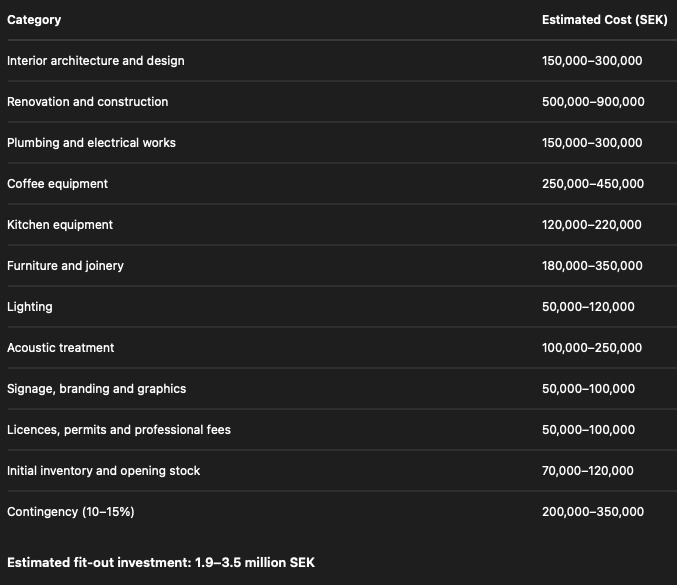
Estimated Capital Investment
Opening LAMBA requires more than securing a suitable premises. The project combines hospitality, architecture, acoustics, coffee, and cultural programming into a single concept, requiring investment not only in physical infrastructure but also in long-term operational sustainability.
The estimates below assume an ideal scenario: a well-located premises of approximately 70–120 m² in Malmö with good natural light, high ceilings, strong street visibility, and sufficient space to accommodate the concept without major compromises.
The figures should be regarded as planning estimates rather than final costs. Actual expenditure will depend on the condition of the premises, the extent of renovation required, and the final design decisions.
Initial Fit-Out Investment
Working Capital
In addition to construction and equipment costs, sufficient working capital is essential during the first year of operation.
This reserve allows the business to absorb slower trading periods, seasonal fluctuations, and the time required to establish a loyal customer base.
Working capital should cover:
Rent
Salaries
Utilities
Insurance
Coffee, food and retail inventory
Marketing
Equipment maintenance
Unexpected operational costs
Recommended working capital reserve:600,000–1,000,000 SEK
Total Recommended Capital
Combining the fit-out investment with an appropriate working capital reserve results in a recommended total starting capital of:
2.5–4.5 million SEK
This range represents a well-funded project that can be completed to a high standard while providing sufficient financial stability during the first year of trading.
Existing Assets
The required investment can be reduced where existing assets are already available.
For LAMBA, several significant elements are already in place:
Professional hi-fi equipment
An established international audience through My Analog Journal
Relationships with artists, selectors, and cultural organisations
Existing brand recognition and visual identity
A fully developed concept and operational strategy
These assets reduce both development costs and marketing expenditure while strengthening the project’s long-term commercial position.
Capital Allocation
Not all investment categories contribute equally to the long-term success of the project.
The highest priorities should be:
Securing an exceptional location
Architectural quality
Acoustic design
Coffee equipment
Furniture and overall guest comfort
Areas such as retail, additional equipment, merchandise, and expanded programming can evolve gradually as the business grows.
Property Strategy
The condition of the premises will have a significant impact on the total investment required.
While a vacant shell offers maximum design freedom, it also carries the highest construction costs and longest development timeline.
Where possible, an existing café or hospitality venue with functioning services—including plumbing, electrical infrastructure, ventilation, food preparation facilities, and customer toilets—may provide a more financially efficient starting point.
Adapting an existing hospitality space can substantially reduce renovation costs, shorten the construction programme, and allow a greater proportion of the investment to be directed towards the elements that define the LAMBA experience: architecture, acoustics, furniture, coffee, music, and community programming.
Funding Strategy & Development Philosophy
Building LAMBA Responsibly
The objective is not simply to open LAMBA as quickly as possible, but to build a place capable of serving its community for many years.
This requires balancing creative ambition with financial responsibility.
Rather than maximising debt or compromising the concept in order to accelerate the project, LAMBA follows a staged development approach. The intention is to invest where quality has the greatest long-term impact, while allowing other elements to evolve naturally over time.
The opening of LAMBA should mark the beginning of a long-term project, not the completion of a construction budget.
Investment Priorities
Certain aspects of the project define the identity of LAMBA and should not be compromised.
These include:
An exceptional location within the right neighbourhood
Abundant natural daylight
High ceilings and strong architectural character
A calm, welcoming spatial atmosphere
High-quality acoustic design
A carefully considered coffee programme
Genuine hospitality
Long-lasting materials and craftsmanship
These elements form the foundation of the experience and cannot easily be improved after opening.
Elements That Can Evolve
Not every aspect of LAMBA needs to be completed before opening.
Several components can develop gradually as the business and its community grow.
These may include:
Additional furniture
Expanded retail offering
Merchandise
Library and book collection
Interior planting
Decorative elements
Seasonal menu additions
Additional coffee equipment
Expanded cultural programming
Natural wine programme (subject to licensing)
This phased approach allows investment to be directed first towards the elements that have the greatest impact on daily operations and guest experience.
A Layered Funding Strategy
The financial strategy for LAMBA is intentionally diversified.
Rather than relying on a single funding source, the project is designed around several complementary layers.
Layer One
Founder Capital
The project begins with personal investment from the founders and support from family.
Founder capital provides independence during the early stages and demonstrates long-term commitment to future partners and collaborators.
Layer Two
Strategic Partnerships
Where appropriate, LAMBA will seek partnerships with companies whose products and values align with the project.
Potential collaborators may include:
Coffee roasters
Coffee equipment manufacturers
Furniture makers
Lighting manufacturers
Hi-fi companies
Ceramic artists
Book publishers
Independent magazines
Design brands
These partnerships are intended to create mutual long-term value rather than conventional sponsorship.
The objective is to reduce unnecessary capital expenditure while introducing products and craftsmanship that strengthen the overall experience.
Layer Three
Community Crowdfunding
LAMBA has grown from a community built over many years through My Analog Journal.
Should additional funding be required, crowdfunding offers an opportunity not only to raise capital but also to invite that community to become part of the project’s story.
Rather than functioning as a donation campaign, crowdfunding would focus on meaningful participation.
Potential rewards may include:
Founding Member status
Early access to the café
Invitations to preview listening sessions
Limited edition merchandise
Signed prints or publications
Recognition within the Founding Supporters archive
The primary value of crowdfunding lies not only in financial support but also in strengthening a sense of shared ownership and belonging.
Layer Four
Long-Term Investment
External investment may be considered only where it strengthens the long-term sustainability of the project without compromising its identity.
The ideal investment partner is not simply a financial backer, but someone who understands the cultural ambitions of LAMBA and supports patient, sustainable growth.
Maintaining creative independence remains a central principle throughout the development of the project.
Growth should never come at the expense of the values that define the experience.
Measuring Success
LAMBA is not designed as a high-volume hospitality business driven solely by customer turnover.
Success will be measured through a broader set of indicators, including:
Financial sustainability
Repeat local customers
Community participation
Quality of cultural programming
Long-term partnerships
Staff wellbeing
Reputation within Malmö
Contribution to the city’s cultural life
Commercial success is essential, but it is viewed as the result of creating lasting value rather than the sole objective.
A Long-Term Perspective
Every successful neighbourhood institution begins modestly.
The objective is not to create a finished project on opening day, but to establish a strong foundation capable of evolving over many years.
Furniture may change.
The retail selection may expand.
New collaborations will emerge.
The programme will grow alongside the community.
What should remain constant is the intention behind every decision.
LAMBA is designed to become more valuable with time, not because it becomes larger, but because it becomes more deeply rooted in the lives of the people who use it.